
Interfacing with ‘jmail’: immersive true crime for the post-platform age
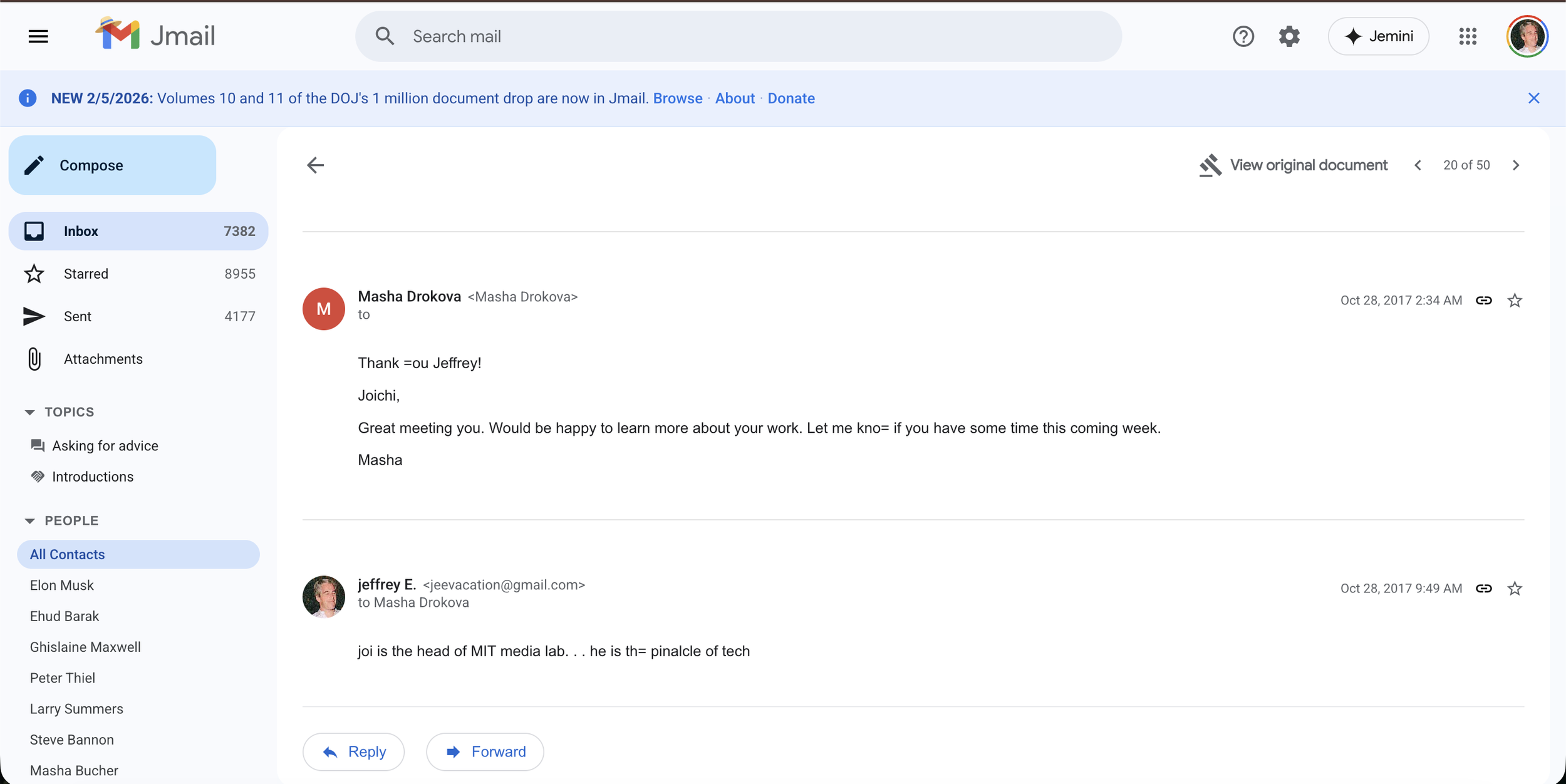
screenshot from jmail, discussing joi itoi - former director of MIT media lab
The epstein files have been at the forefront of the internet the past few weeks. it’s also become a node for content creation. livestreamers, commentators, tiktokers, theorypilled nihilinstagrammers, traditional newspapers, untraditional newspapers, tabloids, substacks. his crimes and the severity of his social network have given the world of content creators enough to talk about for decades. what has specifically been on my radar, as a scholar of interfaces (among many other things), is the publicly available, immersive epstein email experience: jmail dot world.
epstein’s emails are searchable thanks to a website called ‘jmail dot world’ which allows the user to enter a gmail-like interface from the viewpoint of j. epstein and search through the emails using a search bar. it also has additional features like an AI assistant, spotify, maps, i-messages etc. (all named using j. epstein puns, i.e. jemini, jacebook, jamazon) has appeared in the churning chaos of the virtual world.
jmail world was created by a ‘san francisco prankster’, artist, programmer Riley Walz (called a ‘tech jester’ by NYT), and Lucas Igel, a web developer who I couldn’t find much information on (he has a linkedin). the website was launched in november 2025, and it is successful into sucking you into the lurid world of the whole operation through a clone of an everyday digital interface. it is horrific and mundane at the same time.
i spent quite a few hours reading the emails and exploring the site this week.
the interface is sleek and easy to use, just as any other ‘google product’. the ‘messages’ are clearly a clone of apple’s imessages, blue text bubbles and all. if you are one of the millions of people who use these products on a daily basis, searching through epstein’s messages and emails is easy and intuitive. it feels like snooping through someone’s phone. the banality of the familiar interface contrasted against the obscure violence and nastiness of the content makes for a troubling digital experience.
so now, if you so choose, you can read this criminal’s emails for hours. this monster with an immense global network of unthinkable political and economic reach, connected to other useful monsters across the world, has left behind a digital footprint (just like the rest of us). and part of the mark he’s left on the world is being reconstructed through some of his emails. in fact you can now simulate a small part of his digital experience - see his side of the communicative internet through his beady eyes.
running through his emails, searching up key words, googling ‘sender names’ and ending up on conspiracy subreddits and modeling agencies’ websites - this mix of curiosity and dread i felt being on the jmail website was comparable to the emotions i go through when listening to a true crime podcast. the ordinary appeal of the bootleg-gmail interface, its everydayness, made me rethink how true crime is changing in the upcoming post-platform age.
questions about this change started to float into my mind, but i couldn’t come up with many answers:
what do we want to do by donning the digital mask of epstein, reeling in bits of the underworld into our waking life? are we in search of ‘the truth’? and for what purpose? what else is there to know and to feel?
why do we want to immerse ourselves into a true crime daydream through a clone of a familiar digital space?
is jmail the start of something new?
is this the death of the true crime documentary and the emergence of the ‘post-platform true crime experience’?
horror and true crime entertainment may be moving away films to simulated and cloned interfaces as a mode of experience.
from charles manson’s debut album to epstein’s inbox: will true crime media ever be the same after jmail.world?
i have no answers as of yet.
