
Punch and the calamity of being a social media animal
Both human and animal dignity is in crisis in 21st century’s fast-image-culture. Images of atrocities, genocide and war are ready for consumption at a moments’ notice as “we are bombarded by images”. Pain is an easy node for digital attention, like outrage and shock. Clicks and scrolls amplify the representation of one’s pain in the circulatory system of the internet. Is your pain lessened by the internet? Maybe so. Maybe you want to be remembered. Maybe your pain must to be memorialised. Maybe the internet is the only place left where you can reclaim your agency and dignity. People can consent to their pain being archived on the internet. This is a given, an obvious fact, in the human world. But what about the pain of animals?
Punch is a baby Japanese macaque, or snow monkey, who lives at the Ichikawa City Zoo in Japan. He was abandoned by his mother, who was uninterested in raising him and, so, is currently being hand-reared by the zoo workers. Punch has also been facing challenges integrating with the other monkeys in his enclosure, as they exclude and bully him. To help him emotionally as he navigates these difficulties, his keepers gave him an orangutan toy (the ones they have in IKEA) which Punch has taken to. In the many viral videos and images of Punch posted by the zoo, we can see him playing with and hugging the toy and seeking comfort from it whenever he is bullied or intimated by other monkeys. His images, videos and backstory went viral on the internet in the beginning of February after the zoo made a post about him. Many people online seemed to feel bad for this little monkey, and to relate to its pain (through an anthropomorphised lens of ‘being bullied’, an ironic meme about the inevitability of ‘the mother wound’, etc.).
An exploratory search online about the pain of this young animal, yields in subreddit discussions about the social brutality of the animal world, that doesn’t just include monkeys but also chickens, dogs and other hierarchically organised species. These discussions often lead to the somewhat ‘comforting’ conclusion that Punch is going through a sort of common, ritual hazing ceremony that helps to place him within the working hierarchy of the troop… That even if his mother was there (to protect him from the worst of the assaults), he would still have to go through the bullying, so he could, one day, be considered a real adult member of the monkey in-group. That Punch’s pain is not out of the ordinary, in fact, it’s normative in the ‘dog-eat-dog’ world of the non-human creature sphere.
My problem however is not that Punch is going through non-normative, ‘abnormal’, levels of pain for a Japanese macaque held in a zoo, but that its pain is now viral content. Am I too woke? Maybe so. So then, let me say this: Punch is another example of why the viral animal video industrial complex has compounded our already monumental karmic debt to monkeys and dogs.
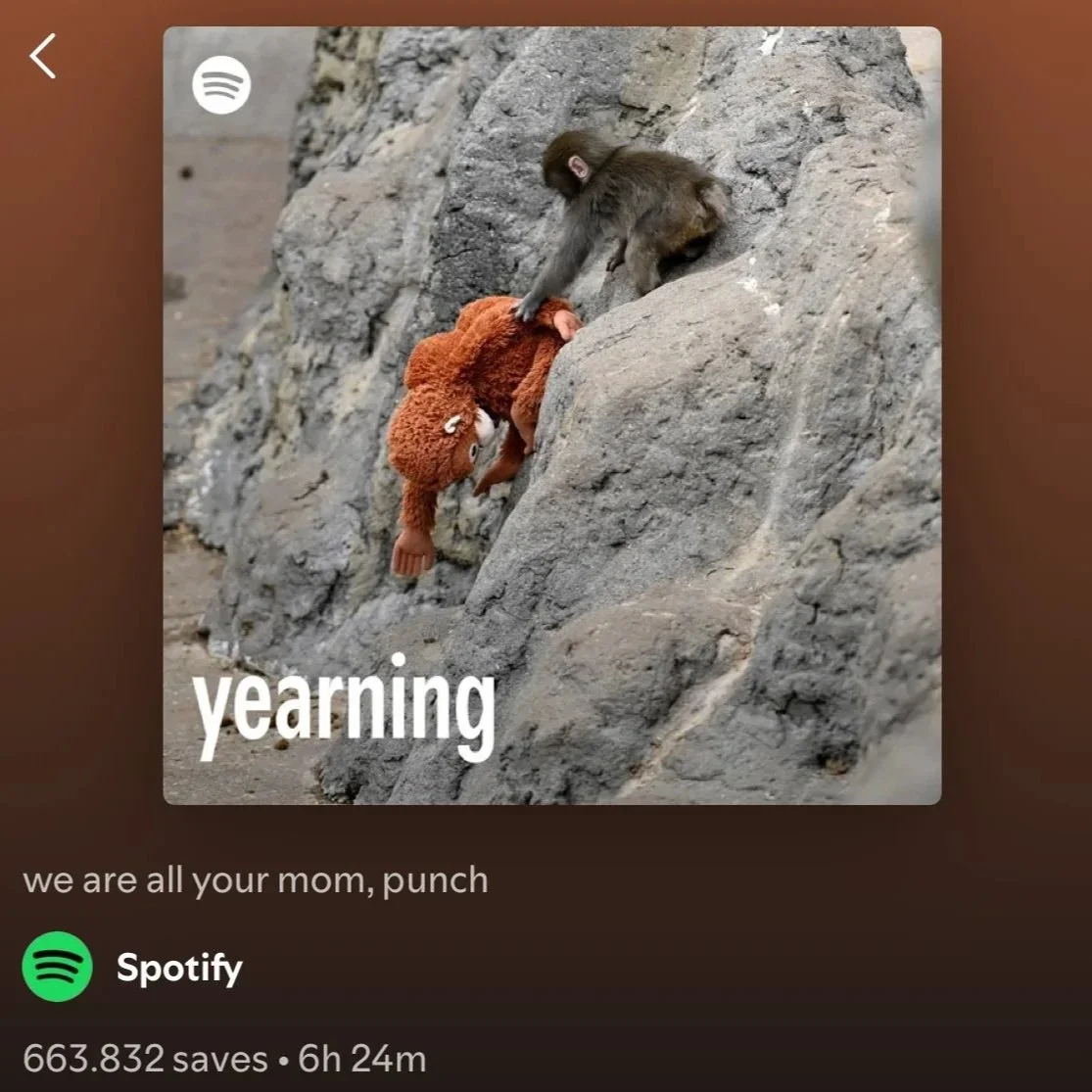
A screenshot of the Spotify playlist cover, Feb 25 2026.
A photo of Punch reaching out for his orangutan toy is now the cover of Spotify’s playlist for “Yearning” (I’ll get to “yearning” as a topic in itself in a different blogpost). The caption for the playlist reads “we are all your mom, punch”. The fact of the matter is, we are not your mom punch. We are a mass of bystanders with their phones out. We watch the normatively-acceptable pain of random animals so that we can ‘yearn’, once again, for ourselves. For our own mothers, our childhoods, our unhappiness, losses and rejections. Punch is an emotional stand-in for the humans watching him. He was already born in a zoo. Now, videos of him being beaten up by other monkeys have gone viral. The zoo keeps posting more videos of him being flung about, they keep getting more and more engagement. It’s all so abject.
The little monkey is transformed by the surveillant gaze of the online crowds. Punch, a previously ‘unknown’, ‘nameless’ creature with volition, is now a reflective surface for Man. Its pain is ultimately another blip in the animal video industrial complex (full of much, much worse stuff like pet monkeys in makeup and skirts). The virality of Punch’s pain has resulted in a spike in visits to the Ichikawa City Zoo. Perhaps that’s a good thing for Punch. I am not really sure.
Many are still curious and they want to follow Punch’s heart-wrenching story. They want to see him win, because he is an underdog. People want to know: “Will Punch make friends? Will the others stop bullying him? Will he be accepted by this hierarchical monkey society that stomps on the weakest, when they’re down?
Will his story help heal my childhood trauma?”
