
October 23rd, 2026. Amsterdam
An eccentric’s handbag
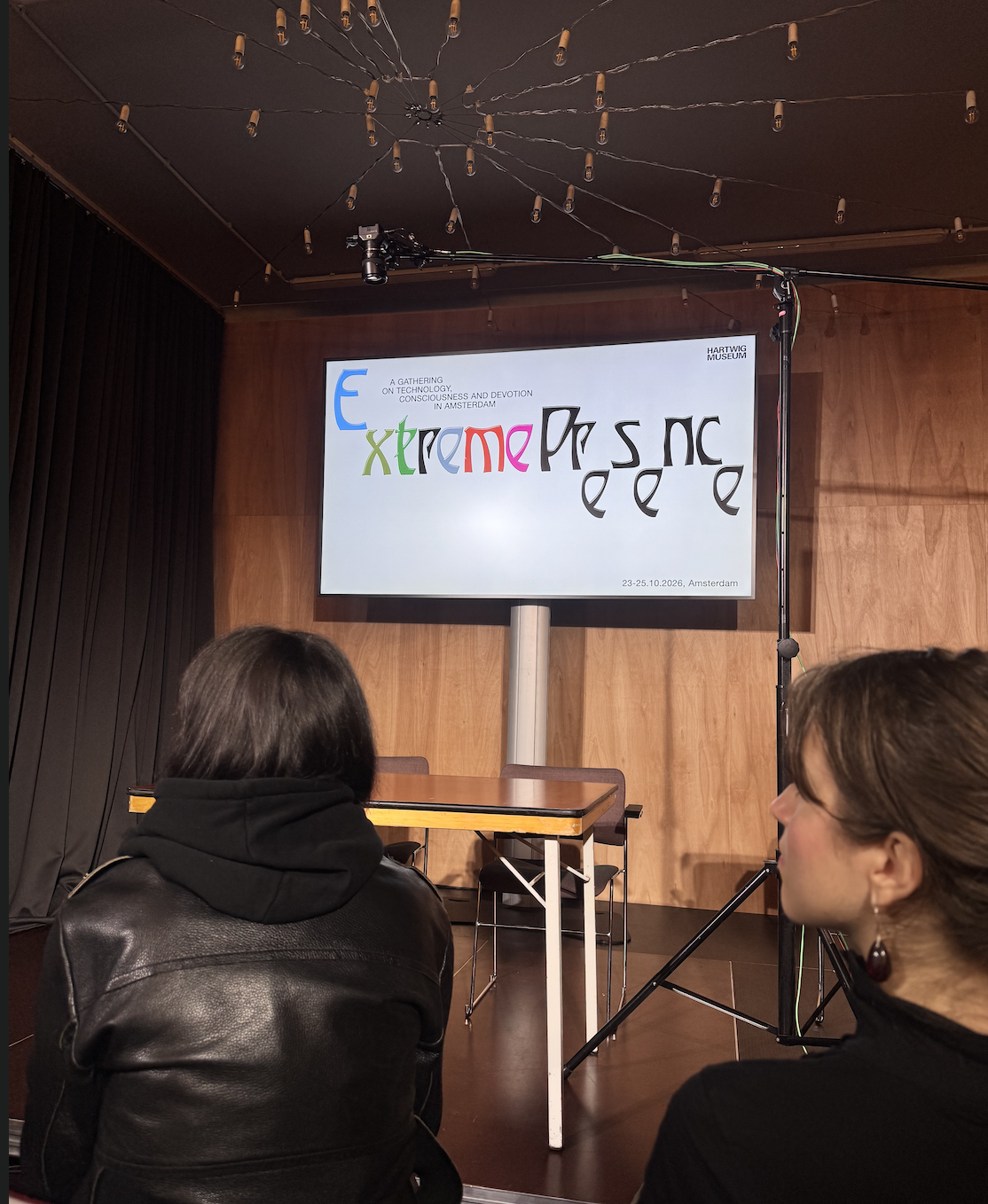
On Friday evening, I went to Hartwig Proxy in Amsterdam Zuid for the opening of Extreme Presence, a three-day gathering organised by the Hartwig Art Foundation around technology, consciousness and devotion. One question running through the evening was whether contemporary art and technology were undergoing a devotional turn. Theology, mysticism and artificial intelligence would be brought into conversation, presumably to see what happened when they were placed in sufficiently close proximity.
The programme was called Devotional Technologies. I was curious, not least because the renewed interest in religion among certain corners of the technological and cultural intelligentsia has begun to seem less like an eccentricity than an emerging convention. Angels, occult intelligence, eschatology, non-human consciousness: these are no longer especially surprising subjects to encounter at an event about artificial intelligence. I wondered what this renewed theological imagination might offer our understanding of AI, beyond the pleasure of provocation.
Hartwig is preparing to establish a permanent museum across the street from its current temporary space. Its director, Beatrix Ruf, opened the evening, followed by Lucia Pietroiusti, the foundation’s Head of Research & Emergence and curator of the programme. Ruf, in a black silk shirt and dark-rimmed glasses, had the composed appearance of someone who had spent a considerable portion of her professional life being photographed in the vicinity of important art. The museum’s unfinished building stood as a reminder that the institution was making a rather substantial commitment to its future presence in Amsterdam. It was then that I truly understood why the programme was called Extreme Presence.
The audience had been given a thoughtfully produced booklet with space for notes, accompanied by branded pencils. The arrangement was pleasingly scholastic. There were also reasonably priced drinks and, as I would discover later, free tea, crisps and pickles. Whatever else one might say about the devotional turn, Hartwig had made provision for its material requirements.
The first performance was a book launch for Mirror Tarot: A Machine for Constructing Stories, by Sarah Shin and Sammy Lee. The two artists appeared in coordinated but not identical ensembles of layered black clothing, occupying a familiar intersection of contemporary East Asian streetwear, post-internet goth and normcore. There were oversized garments, plenty of layers and some excellent hats. They both looked rather wonderful.
The performance began with the duo unpacking a small orange suitcase on the platform. They removed a quilt, spread it across the table and began arranging objects upon it. An overhead camera projected their movements onto the screen behind them.
A friend leaned over to remark that Mindy Seu had really popularised this sort of overhead camera setup. Where would we all be without Mindy Seu? I thought.
The artists proceeded to populate the quilt with a miniature collection of objects: a blue 3D-printed castle-like structure, a pair of pink embroidered shoes resembling something a small child might wear for a special occasion, colourful ornaments and assorted knick-knacks, each carefully placed and occasionally rearranged.
The result resembled a temporary shrine, a child’s imaginary world, or the contents of an eccentric’s handbag. I liked the care with which the objects were handled, and the small adjustments the performers made as the arrangement developed.
The project draws on Italo Calvino’s idea of tarot as a machine for constructing stories. Shin and Lee use the cards as prompts for speculative fiction, interpretation and worldmaking. Tarot already provides a system of images, conventions and possible narratives. It is, among other things, a technology for generating meaning from combinations.
Eventually, they laid out the tarot cards. The accompanying publication offers short fictional passages associated with the deck. One artist would identify a card while the other read from the book, constructing a narrative through the sequence of the reading.
As a performance, this was fun. As literature, I was less convinced.
The fragments belonged to a recognisable contemporary tradition of esoteric speculative writing, the kind of miniature theory-fiction that circulates extensively through certain corners of the internet and independent publishing. Its atmosphere was familiar: mystical suggestion, speculative world-building, the promise of an elaborate metaphysics just beyond the boundaries of the text. The passages I heard relied on an established vocabulary of mystery and possibility without developing enough narrative or conceptual tension to make that vocabulary interesting in its own right.
The performance’s material inventiveness was another matter.
At one point, a passage called for a sound. One of the artists picked up a small fidget cube and began pressing its buttons, producing a series of delicate, tactile clicks. The sound had an unmistakable ASMR quality.
I liked this enormously. Fidget toys are generally associated with distraction, self-soothing and the management of attention. Here, a cheap little device became an instrument of ritual. Nobody needed to pretend that it was anything other than a fidget cube.
Even when the writing failed to convince me, the handling of objects, gestures and sounds held my attention.
A philosopher’s personae
Lukáš Likavčan followed with a presentation on Persona Sculpting, an exploration of artificial intelligence, contemplative practice and the construction of personae. He had a splendid speaking voice, excellent enunciation and an enviable command of time. His presentation was accompanied by evocative images, and his delivery was measured without becoming monotonous. He also looked rather like a philosopher who had wandered out of the 1971 Chomsky–Foucault debate.
He read from a prepared text, and did so very well. There was something almost reassuring about the competence of it. I have attended enough experimental lectures to know that the ability to finish a complicated argument within the allotted time is not a universal accomplishment.
His lecture moved through several autobiographical vignettes, including an encounter with an image of Guanyin in a cave in China and a recollection of visiting a Gothic church in Paris as a teenager. The latter involved the narrative possibilities of stained glass, which he described in relation to an architecture of storytelling. These were beautifully constructed passages.
The central proposition, as I understood it, concerned the distinction between persons and personae in thinking about artificial intelligence. An artificial agent might be understood through the roles it assumes, the forms of agency delegated to it, and the relationships people establish with it, without first deciding whether it possesses the consciousness or ontological status of a human person.
I liked that this offered a way around the tiresome question of whether machines are merely tools or persons in waiting.
Likavčan also invoked Michel Foucault’s technologies of the self, a concept I have worked with in my own research. In an article on music recommendation systems, my co-authors and I examined how Last.fm users employed algorithms to cultivate their musical tastes, treating the system as a kind of intimate expert.
I found myself thinking about AI agents as attachments of human will. An agent configured to act on my behalf is neither identical to me nor wholly independent of me. Somebody has established its permissions, instructions and possibilities, although that somebody might not be the person using it.
When an agent acts, whose intentions does it express? What happens when its actions depart from the intentions of the person who deployed it? And who is responsible when increasingly complicated forms of judgement are delegated to synthetic personae?
Likavčan was generous with references and personal associations. We heard about the thinkers he knew, the people he was friends with, and the intellectual worlds through which he moved. This is hardly unusual in contemporary art discourse, where naming theorists and collaborators performs a social function alongside an explanatory one. References establish intellectual genealogies, but they also establish belonging. The audience is invited to recognise an argument as well as a social-intellectual network.
I have spent enough time in academic environments to understand these conventions, and probably participate in them myself more often than I care to admit. Nevertheless, I find their more conspicuous forms irritating. The pot calling the kettle black, perhaps. Alas.
Some of the language also seemed unnecessarily dense. It was comprehensible (to me, of course, as someone with a PhD from the University of Edinburgh and a master’s from the London School of Economics, and—oh dear… I’ll stop), but occasionally demanded more work than the underlying ideas required.
I enjoyed Likavčan’s lecture. His delivery was excellent, his propositions interesting, and his willingness to bring together personal experience, philosophy and speculative technology made for an engaging presentation. It gave me plenty to think about, which is more than one can reasonably demand of every lecture.
Europe’s angels
Bogna Konior appeared on Zoom.
There were some technical difficulties, which seemed appropriate for an evening devoted to Extreme Presence. The person about to make some of the evening’s most forceful propositions about artificial intelligence and theology was temporarily subject to the familiar humiliations of the online meeting.
I had been curious about Konior for some time. Her name had circulated through the online theoretical environments I frequent, particularly in connection with The Dark Forest Theory of the Internet. She seemed to occupy an interesting position within a contemporary intellectual culture in which philosophical speculation, internet aesthetics and deliberate provocation increasingly overlap. I knew her reputation more than her work. I had not read her book, and this was my first sustained encounter with her thinking.
Her presentation was titled Applied Theology for AI Agent Design.
Konior began by describing her participation in a gathering of theologians discussing artificial intelligence at an archbishop’s palace in Poland. She returned to this encounter more than once, evidently regarding it as significant. I found this immediately curious. It is not every day that one attends a contemporary art programme on advanced technology and discovers that an archbishop’s palace has become an important site of intellectual activity.
She subsequently explained her Catholic upbringing, including her education by nuns and her continuing relationships with religious communities. Her account was unexpectedly affectionate. Much of what I have heard about such environments, particularly from people educated by religious orders, has been rather less enthusiastic. It was interesting to encounter someone who regarded that formation as a continuing intellectual and spiritual resource.
Her presentation was provocative, funny and, at moments, rather exhilarating. She appeared quite willing to make propositions that might offend the sensibilities of an audience accustomed to approaching religion through a largely secular theoretical vocabulary.
I appreciated this.
The difficulty began when she expressed her desire to see Europe become a vanguard of artificial intelligence discourse by drawing on its Christian theological heritage.
Here I became considerably less sympathetic.
Christian theology certainly contains elaborate accounts of personhood, agency, mediation, obedience, transcendence and relationships between human and non-human beings. There is plenty there for anyone interested in artificial intelligence.
The suggestion that Europe’s Christian inheritance should provide a privileged foundation for its technological future, however, struck me as politically and historically loaded.
Why Christianity? Why Europe? And what, precisely, was being claimed on their behalf?
Europe’s intellectual history is not reducible to Christianity, and Christianity’s institutional history is hardly separable from questions of authority, exclusion and political power. To invoke that inheritance as a resource for technological development without attending to these histories risks treating theology as a conveniently available conceptual library.
It was especially interesting to hear this proposition from someone who had co-edited Machine Decision Is Not Final, a collection concerned with expanding the frameworks through which artificial intelligence is understood, particularly through Chinese technological and intellectual histories. One can study Chinese technological thought and also argue that Christian theology offers valuable resources. I still wanted to know why Europe should occupy a vanguard position.
My own historical perspective undoubtedly shapes this reaction.
I grew up in a Turkish secular tradition in which institutional religion was frequently understood as an obstacle to intellectual and political modernisation. My family history, however, is rather more complicated.
My great-grandfather was a müderris, a scholar and teacher at a madrasa in Edirne, one of the Ottoman Empire’s great centres of Islamic learning. Edirne is, incidentally, in Europe.
My great-aunt was a mystic healer who commanded considerable respect among those who believed her healing powers came from her knowledge of the Quran and her relationship with God. In the small post-Ottoman enclave in Greece where she lived, the villagers called her “Galip’s mad daughter”. Within the family, however, she was remembered as a woman of exceptional intelligence and ambition, perhaps more than her circumstances could accommodate. Her brothers pursued public careers, one as a politician and another as a poet and journalist. She might have become a scholar or teacher herself. Instead, she devoted her intellectual energies to religious learning and healing, through which she acquired considerable authority in her community. According to family accounts, she grew bitter about the opportunities denied to her.
I often wonder how much of her devotion was a matter of religious conviction, and how much was shaped by the possibilities available to her. I have no reason to doubt the sincerity of her faith, but neither can I assume that she would have chosen the same life under different circumstances. Religious institutions have provided opportunities for intellectual life while also determining who could participate in it, and on what terms. When devotional traditions are recovered as philosophical resources, it is easy to admire the ideas they produced without paying much attention to the circumstances of the people who sustained them. I am wary of making religious life seem more freely chosen than it necessarily was.
Konior described herself as post-secular, a position I cannot quite claim for myself. Still, I can appreciate the desire to look beyond the intellectual habits of one’s own discipline, particularly when those habits have hardened into conventions. Philosophical traditions have a way of becoming institutionalised themselves, acquiring their own orthodoxies and predictable vocabularies. Contemporary media theory is hardly innocent of this.
At one point, Konior dismissed what she characterised as a kind of hippie-dippy Spinozist immanence. The remark was delivered with recognisably contrarian relish.
I found this rather entertaining. Much of contemporary media theory has been shaped by Deleuzian and post-Deleuzian philosophical traditions, and references to immanence, assemblages, flows and becoming have become sufficiently commonplace to constitute something resembling a professional dialect.
I have never felt particularly compelled by the expectation that every discussion of technology should eventually pass through Deleuze.
It was a good joke, although dismissing a vocabulary is easier than showing what should replace it.
Konior also suggested, at one point, that angels were material. I would have welcomed a more sustained account of what materiality meant in this context. It was an intriguing proposition given the evening’s concern with intelligences frequently imagined as immaterial while depending on extensive physical infrastructures.
Another moment that troubled me was a reference to Richard Dawkins’s memetics in connection with language. I have spent a considerable portion of my academic life researching memes and the limitations of treating culture through evolutionary biological analogies, so my ears pricked up. Classical memetics tends to imagine cultural forms as discrete replicating units, and has trouble accounting for interpretation and social context. I could not tell from the brief reference how much of that framework Konior intended to take on. I would have liked to hear more about what the analogy was meant to explain.
I was also struck by the way Foucault’s technologies of the self resurfaced in Konior’s argument.
I understood her to be suggesting that practices of self-formation required something outside the subject, possibly connecting that externality to divine presence or authority. I may have misunderstood the extent of the claim.
Technologies of the self are not exercises in sovereign individualism. They involve historically constituted practices, relationships with others, institutions, forms of knowledge and techniques through which people act upon themselves.
The involvement of something external to the individual does not, on its own, establish the necessity of divine authority.
Foucault’s examination of Christian practices of confession and spiritual direction concerns historically specific relationships between self-knowledge, obedience, renunciation and power. To turn this genealogy into a general argument for the necessity of transcendence would require considerably more explanation than I heard.
Perhaps she was making a narrower claim. The occasional instability of the Zoom connection did not help, and I would want to return to her published work before deciding exactly where our interpretations diverged.
I was nevertheless left with the impression of an argument moving rapidly between provocative propositions without always establishing the relationships between them.
The materiality of angels
The question of materiality returned during the audience discussion.
Someone asked about the political economy of artificial intelligence: the data centres, underwater cables and other infrastructures that make contemporary AI systems possible. Why, the questioner wanted to know, was this material dimension absent from the discussion?
Konior responded, as I noted it down: “I don’t care about that question.”
She then continued speaking for several minutes.
It was an extraordinary response, partly because the dismissal was followed by an extended explanation, and partly because the question seemed so obviously relevant to the subject under discussion.
AI systems are produced through computation, labour, investment, energy consumption, data extraction and institutional decision-making. Their apparent autonomy depends on physical arrangements that are neither neutral nor evenly distributed.
There is plenty of room for metaphysics, speculative philosophy, mysticism and even angels in discussions of artificial intelligence. Yet when a speaker proposes that religious traditions might inform the construction of future technologies, I want to know something about the institutions and infrastructures responsible for building those technologies.
A philosopher can reasonably delimit the scope of an argument. No single presentation can address every dimension of artificial intelligence. Declaring that one does not care about a question, however, is a peculiar way of explaining why it falls outside one’s inquiry.
I had been stimulated by Konior’s ideas. I admired her rawness and her willingness to make ambitious, potentially unpopular claims. She brought life to subjects that are often rendered inert by solemnity and procedural caution.
What I struggled with was the status of the propositions themselves. How was I meant to take them? As philosophical arguments, speculative experiments, deliberate provocations, or performances whose meaning depended on the audience’s reaction?
It could have been several of these things at once.
Afterwards, I spoke to several people familiar with her work. Some suggested that her public interventions should be understood partly as provocations rather than straightforward statements of conviction.
This explanation did not particularly reassure me.
I am perfectly capable of appreciating Konior’s presentation as performance art. In that capacity, I thought it rather good. She brought a welcome irreverence to a discussion that could easily have become insufferably solemn.
Perhaps it is naive to want people to mean what they say. I am willing to accept that I may be naive in this respect. I am simply not very interested in the competitive business of out-edging one another, or in intellectual settings where the ability to advance the most startling proposition is treated as evidence of having thought the furthest.
Philosophy has always made room for fiction, satire, exaggeration and experiments with form. Nor does intellectual conviction require certainty. A person can be deeply committed to an argument while remaining willing to revise it.
What I want is some indication of what the argument is prepared to risk.
There is a peculiar convenience to the contemporary theoretical appetite for provocation. Intellectual claims can circulate with considerable force while their authors retain a degree of ambiguity about how seriously those claims ought to be taken. When challenged, a proposition can retreat into the status of an experiment. When celebrated, it can reappear as a serious intervention.
This becomes more complicated when the propositions concern institutional religion, political authority and technological futures. Ideas do not cease to have consequences because their authors approach them playfully.
The intellectual traditions surrounding contemporary speculative theory have themselves taken seriously the possibility of hyperstition: fictional and speculative constructions that participate in producing the realities they describe.
If speculation can act upon the world, its practitioners ought to have some interest in what kind of world they are helping to construct.
Who cares for the machines?
Lawrence Lek’s presentation came as something of a relief, although not because it was any less speculative. If anything, his fictional universe was stranger than most of what we had heard that evening.
Lek introduced Guanyin: Confessions of a Former Carebot, a multimedia project set within his ongoing Sinofuturist universe. Guanyin takes her name from the Buddhist bodhisattva of compassion and mercy, but in Lek’s world she works as a therapist for artificial intelligences. Her patients are machines suffering from various forms of psychological distress, including depression.
Even machines, it seems, are having a difficult time.
I loved this premise. It is both very funny and rather sad to imagine a future in which machines have become sufficiently miserable to require their own mental health services. One might have hoped that artificial intelligence would at least spare us the trouble of inventing another class of depressed workers.
Instead, Lek has given us a carebot whose job is to look after them, complete with the institutional arrangements and professional obligations that make caring for others a form of labour.
I had spent much of the preceding presentation wondering what speculative propositions were supposed to do once they had been announced. Lek had imagined a future in which machines suffered from recognisably human afflictions and then gone to the trouble of constructing the social arrangements that might follow.
If artificial intelligences become depressed, who looks after them? Who pays for their treatment? What sort of institution employs a therapist whose patients are machines?
It reminded me of one of the quests in Cyberpunk 2077, involving Delamain, an artificial intelligence that operates a fleet of autonomous taxis in Night City. Several of his vehicles have gone rogue, each apparently developing a personality of its own. One is frightened, another aggressive, and another has acquired an especially unpleasant attitude towards its passengers. The player is dispatched to retrieve them, ostensibly to resolve a technical malfunction.
Except the cars have their own ideas about being retrieved.
I remember finding the quest unexpectedly affecting. It is difficult to treat a malfunctioning taxi as merely defective when it is pleading with you, threatening you, or expressing a rather convincing desire to be left alone.
I can read a philosophical argument about whether an artificial intelligence deserves moral consideration and remain comfortably undecided. A game is less accommodating. When a frightened taxi asks me to leave it alone, I have to decide whether to listen.
Of course, the whole situation has been invented by somebody, including the possible responses. Fiction has always invented situations in which we discover something about our own judgement. Games make that judgement part of the activity.
The philosophical question arrives in the rather undignified form of a dispute with a car.
Lek has been working with technological imaginaries for years. His earlier Sinofuturism (1839–2046 AD) examined the fantasies, stereotypes and anxieties surrounding Chinese technological modernity through an exaggerated science-fictional vocabulary. Guanyin is concerned with care, employment, emotional distress and the peculiar social arrangements that might emerge among artificial beings.
I was particularly taken with what happened to compassion in Lek’s world. Guanyin is named after a Buddhist bodhisattva, but she has a job. Compassion has been assigned a function, given a workplace and made subject to the same organisational absurdities as any other kind of care.
I thought back to the little fidget cube that Shin and Lee had used earlier in the evening. It was an inexpensive object, but in their hands it had become an unexpectedly effective part of a ritual. Lek’s fictional world operated on an entirely different scale, yet I found myself responding to something similar. In both cases, the artists had taken an idea and worked out what could be done with it.
I found myself wondering who was responsible for producing so many unhappy artificial intelligences in the first place. What kind of society would need a machine therapist? And would such a society be any better at caring for its machines than ours is at caring for people?
I had no idea whether machines would ever become depressed. I was, however, quite interested in what Lek had imagined would happen if they did.
Why did God make us?
Ariana Reines was in the audience.
At one point, she asked Konior a question whose simplicity cut through the elaborate theoretical vocabulary of the evening. As I remember it, the question was: Why did God make us?
It was a remarkable thing to ask.
After so much discussion of artificial intelligence, theological inheritance, non-human cognition and the speculative futures of consciousness, here was a question that sounded almost childlike in its directness. It was also an enormous question, one that could not be answered simply by producing another conceptual distinction.
I was delighted.
There was something wonderfully serious about asking it in that room. If we were going to discuss theology, why not ask a theological question?
I had wanted to meet Reines for some time. Among other things, I was interested in her translation of Tiqqun’s Preliminary Materials for a Theory of the Young-Girl, a book whose strange afterlife in contemporary cultural discourse has become almost as interesting as the text itself.
I wanted to ask her about its reception, about what happens when a piece of radical theory becomes an object of fashionable recognition, and perhaps about the odd pleasure of watching one’s intellectual references migrate into the aesthetic vocabularies of younger generations.
Instead, I was starstruck and did not approach her.
There are few things more humiliating than discovering that one’s capacity for critical detachment has limits, particularly in the presence of someone whose work one admires.
I contented myself with being pleased that she was there.
Her question stayed with me. There was no obvious advantage to asking it. It was not especially fashionable or conceptually ornamented. It did not demonstrate membership in a particular intellectual network.
She had simply asked why God made us.
Outside in the rain
By the end of the evening, I had accumulated several pages of notes, a collection of impressions that did not quite agree with one another, and considerable goodwill towards an institution that offered sparkling water free of charge.
Hartwig had organised a thoughtful event. The booklet, the pencils, the drinks and the care taken over the programme all contributed to a sense that the audience was being invited to participate in something rather than merely observe a succession of performances.
At the conclusion of the public programme, the audience was asked to make way for a private dinner. The tables were being prepared, and I caught sight of beautifully arranged food, including something involving carrots and green herb oil. It looked excellent.
My friends and I filed out, our stomachs rumbling. I had briefly entertained the possibility of helping myself to some of those carrots, but apparently they were not for us.
Outside, Amsterdam was wet and unpleasant. People gathered under the available shelter, smoking and vaping, while the rain continued its usual work of making the journey home more miserable than necessary. Just down the road stood the Spinoza Lyceum, with its statue of the philosopher whose ideas had received such an unceremonious dismissal earlier that evening.
Hans Ulrich Obrist had been in attendance, and I spotted him leaving with Beatrix Ruf. At one point she appeared to usher him away, and I watched them disappear into the wet evening, Obrist smoking a cigarette.
Across the street was the building that would eventually become the Hartwig Museum. For now, the institution existed between its temporary premises and its promised future.
References and further reading
The following combines works discussed during the evening, publications by its participants, and additional texts informing my interpretation. Inclusion does not imply that a speaker cited or endorsed a particular work.
Art, fiction and speculative practice
Bogost, Ian (2007). Persuasive Games: The Expressive Power of Videogames. MIT Press.
Calvino, Italo (1977). The Castle of Crossed Destinies. Translated by William Weaver. Harcourt Brace Jovanovich. Originally published in Italian in 1973.
Lek, Lawrence (2016). Sinofuturism (1839–2046 AD). Video essay.
Lek, Lawrence (2024). Guanyin: Confessions of a Former Carebot. Multimedia installation and video game. Commissioned for the Frieze London Artist Award.
Nguyen, C. Thi (2020). Games: Agency as Art. Oxford University Press.
Shin, Sarah and Sammy Lee (2026). Mirror Tarot. Spiral House, an imprint of Silver Press. Portals series.
Artificial intelligence, cybernetics and speculative philosophy
Bratton, Benjamin H., Anna Greenspan, Amy Ireland and Bogna Konior, eds. (2025). Machine Decision Is Not Final: China and the History and Future of Artificial Intelligence. Urbanomic.
Cybernetic Culture Research Unit (CCRU) (2022). Writings 1997–2003. Urbanomic / Time Spiral Press.
Konior, Bogna (2020). The Dark Forest Theory of the Internet. Flugschriften, vol. 6.
Konior, Bogna (2026). The Dark Forest Theory of the Internet. Polity.
Likavčan, Lukáš (2019). Introduction to Comparative Planetology. Strelka Press.
Religion, mysticism and technologies of the self
Asad, Talal (2003). Formations of the Secular: Christianity, Islam, Modernity. Stanford University Press.
Davis, Erik (1998). TechGnosis: Myth, Magic, and Mysticism in the Age of Information. Harmony Books.
Foucault, Michel (1988). “Technologies of the Self.” In Luther H. Martin, Huck Gutman and Patrick H. Hutton (eds.), Technologies of the Self: A Seminar with Michel Foucault. University of Massachusetts Press.
Foucault, Michel (2005). The Hermeneutics of the Subject: Lectures at the Collège de France, 1981–1982. Edited by Frédéric Gros. Translated by Graham Burchell. Palgrave Macmillan.
Foucault, Michel (2014). On the Government of the Living: Lectures at the Collège de France, 1979–1980. Edited by Michel Senellart. Translated by Graham Burchell. Palgrave Macmillan.
Karakayali, Nedim, Burç Köstem and İdil Galip (2018). “Recommendation Systems as Technologies of the Self: Algorithmic Control and the Formation of Music Taste.” Theory, Culture & Society, 35(2), 3–24. https://doi.org/10.1177/0263276417722391
Mahmood, Saba (2005). Politics of Piety: The Islamic Revival and the Feminist Subject. Princeton University Press.
Sahlins, Marshall (2022). The New Science of the Enchanted Universe: An Anthropology of Most of Humanity. Princeton University Press.
Additional cultural reference
Tiqqun (2012). Preliminary Materials for a Theory of the Young-Girl. Translated by Ariana Reines. Semiotext(e).
