
A friend recently told me that I’m really good at self-mythologising. I am here to now inform her, and anyone else who reads this blog, that the correct term is autofiction.
Tomorrow is my birthday (11/11 - angel number). To commemorate this important occasion, I have decided to dedicate this week’s links entirely to myself.
After years of directing public attention towards other people’s cultural contributions, I have concluded that mine have been insufficiently celebrated. This is a serious oversight, and I’m here to rectify that. No more humble academic teas, welcome to the year of the freelancing thought leader.
I have, over the course of around 10 years, written things, made images, founded institutions, developed theories, appeared on screens, and participated in various episodes of online discourse.
As someone professionally interested in the construction of cultural memory, I am aware of the dangers of leaving my legacy to the discretion of others. History is full of talented women whose contributions were never recognised, or only after their deaths, and why not include myself in the camp of talented women?
I have no intention of waiting that long. When the time comes, I might upload my brain into a supercomputer like Grimes intends to. Perhaps our disembodied consciousnesses will be forced to reply to AI bots for eternity on some privately funded server farm.
As such, I hereby appoint myself the official custodian of my own intellectual and artistic estate. All questions of provenance, attribution, historical significance and aesthetic value will henceforth be referred to me. My authority in these matters is absolute and infinite.
TEXT
The Grotesque in Instagram Memes (2021)
In 2021, I was writing about grotesque memes, digital carnivals, abjection, and the aesthetics of internet ugliness, back when the brainrot industrial complex was still in its infancy. Published in the first Critical Meme Reader, this essay traces the grotesque from the accidental rediscovery of Emperor Nero’s Domus Aurea to the incessant carnival of contemporary digital life, drawing on Mikhail Bakhtin’s Rabelais and His World, Mary Russo’s The Female Grotesque, Julia Kristeva’s writings on abjection, Freud’s uncanny, and Viktor Shklovsky’s concept of defamiliarisation.
An important intellectual influence was Gabriele de Seta, whose work on digital folklore helped establish a way of thinking about internet culture through its vernacular practices, collective creativity and strange, unruly forms of expression. Gabriele is one the OGs of digital folklore along with Olia Lialina, and I’m delighted that he subsequently became a friend and co-conspirator in my own adventures in meme research.
Based on my digital ethnography of niche Instagram meme-makers, I examined how grotesque memes emerge from a condition of in-betweenness: between comedy and horror, embodiment and virtuality, platform productivity and platform resistance. I was interested in the relationship between grotesque aesthetics and the material precarity of their creators, whose carnivalesque performances both generate value for platforms and risk algorithmic punishment. These images operate through digital billingsgate, combining vulgar marketplace language, grotesque bodies, intertextual references and ambivalent festive laughter to produce forms of digital folklore that defamiliarise familiar meme formats and digital experiences.
Among the essay’s more significant contributions to human knowledge is a sustained philosophical analysis of horny jail, involving Plato’s theory of desire and the psychic torment of human existence.
I recommend this essay to anyone who enjoys essays about images. There is a bibliography and everything.
SOUND
ALGOpod #10: İdil Galip (2026)
I joined Gabriele de Seta for an episode of ALGOpod, after giving a talk about my new research at the University of Bergen. We discussed post-memetic culture, algorithmic loops, memetic extremisation, algomaxxing (mine!), Pinterest, Kick, and algorithmic captivity. Listen and launder my ideas via chatgpt.
VIDEO
AI Slop: Fecal Matter of Cybercapitalism? (2026)
I make a guest appearance in Aidan Walker’s new video series to recommend Kate Crawford's Eating the Future: The Metabolic Logic of AI Slop, which examines the material and ecological consequences of generative AI through the concept of the metabolic rift. Marx’s collected works are not holy scripture to me, and I’ve drifted far enough from academia to have no patience for turning political economy into a competitive exercise in biblical exegesis, or another arena for reproducing conference-circuit social hierarchies (it’s the revenge of the nerds). I’d rather see some of this stuff being used to understand the world than watch people fight over the correct interpretation of a German noun from 1867. No one but the middle class cares!
IMAGE
Too Cringe for Art, Too Based for Academia, Just Miserable Enough for Instagram
An IG story meme I made in approximately thirty seconds using a meme template and ol’ faithful (Create Mode). It subsequently went viral and enjoyed a more successful career than all of my peer-reviewed publications combined and multiplied by 1000 impact factors. An efficient piece of institutional critique, produced with 0 funding, no peer review or any technical skill. I consider it both a triumph of memetic reproduction and an administrative failure in the management of my artistic estate.
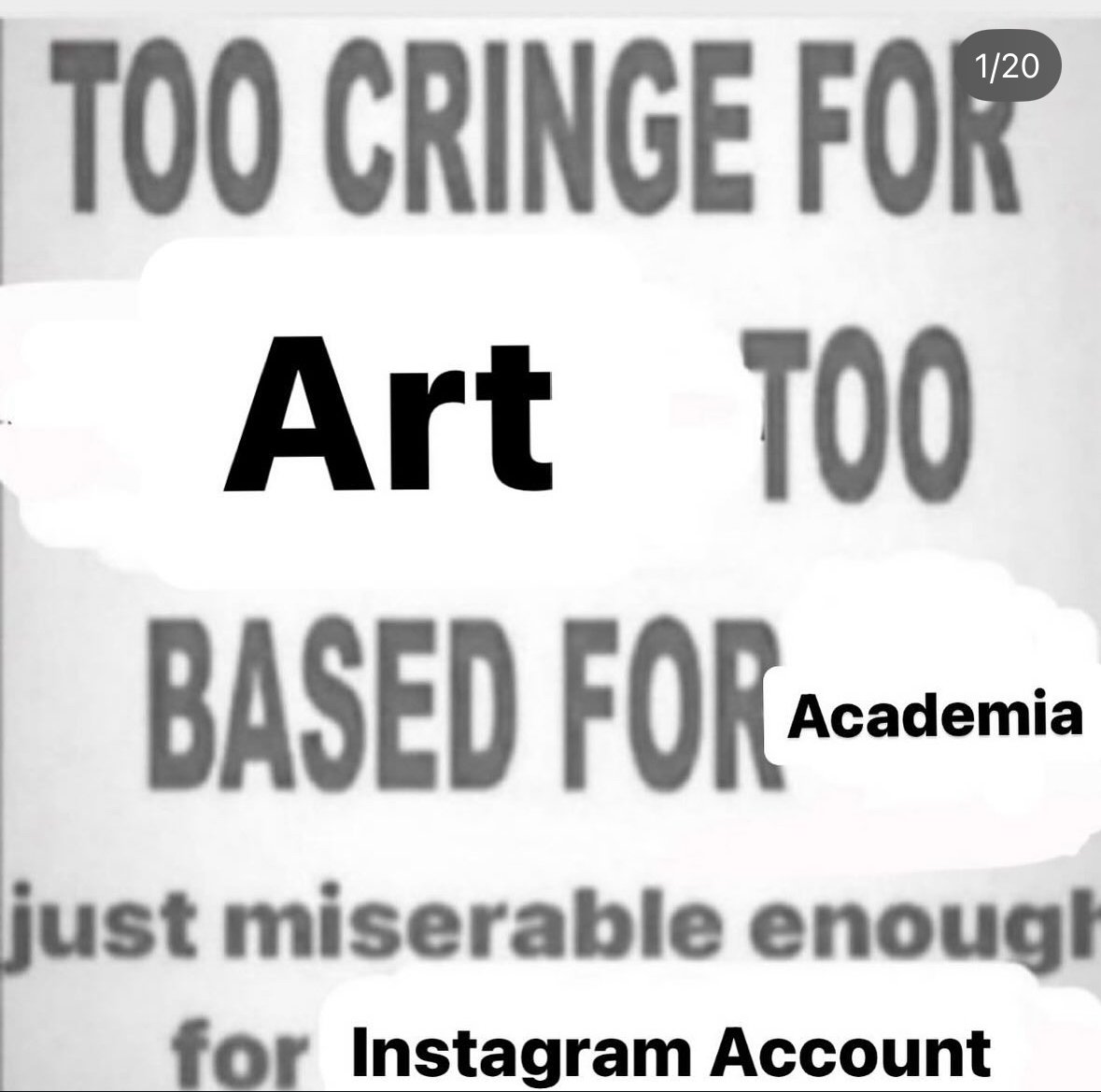
The ‘original’ meme I posted on my story (I added “art”, “academia”, and “instagram account” myself, and the template I ripped from the internet.)
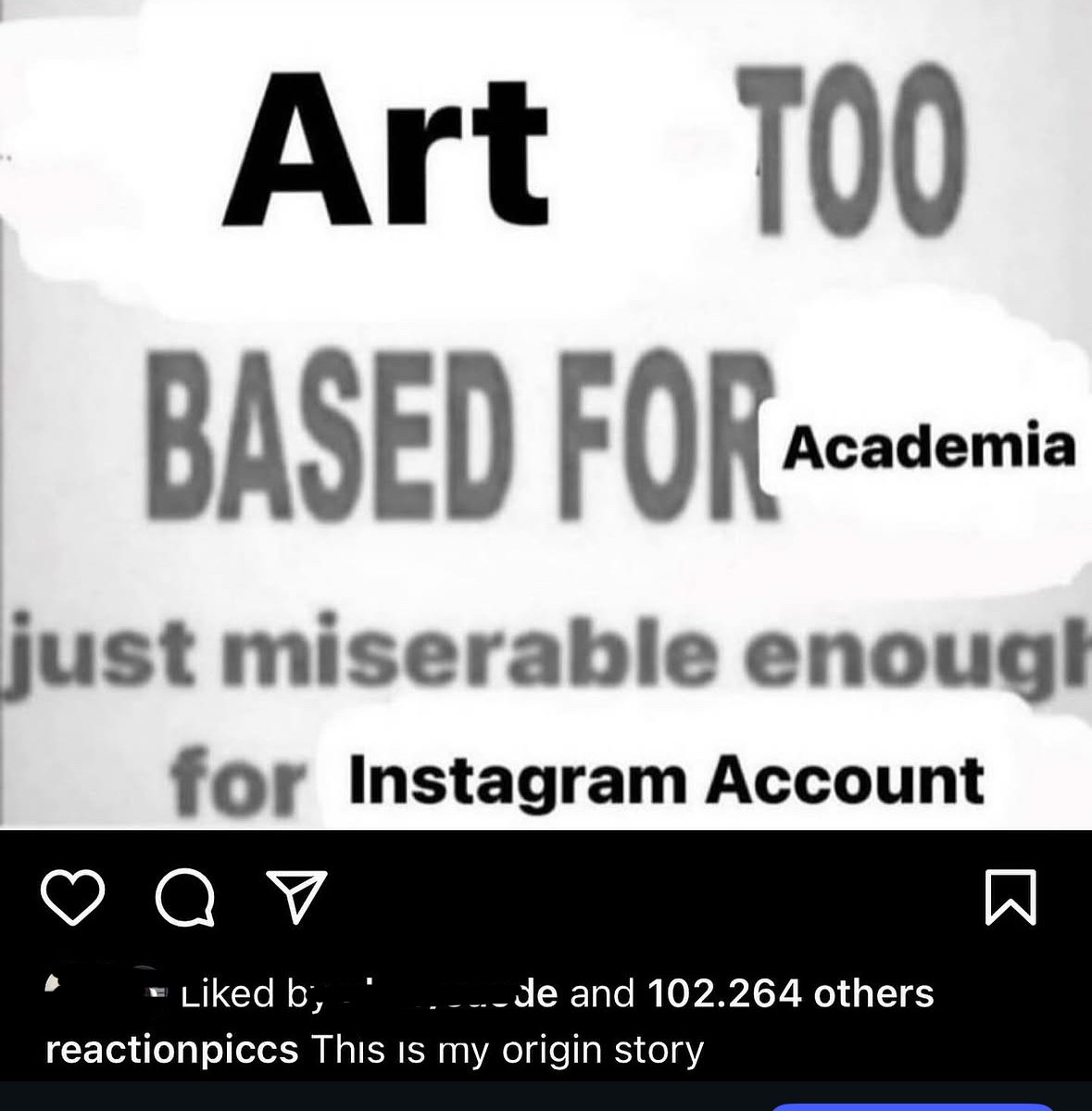
my OC reposted by a meme aggregator. I feel lucky to have connected with over 100,000 souls. This is the collective unconscious.
